
Thresholds of Being: In the Wake of the Self



Group show “Thresholds of Being: In the Wake of the Self” brings together the work of Alfie Rouy and Giulnara Fatullaeva, two artists who see painting as a way to explore transformation.
Alfie Rouy’s vibrant, flowing canvases are inspired by cosmic energy, spiritual symbolism, and surrealist drawing techniques. His works invite you to feel rather than interpret like visual mantras or frequencies that connect us to something beyond the physical world.
In contrast, Giulnara Fatullaeva’s paintings turn inward, reflecting on personal trauma, memory, and the experience of emotional dissociation. Her ghostlike figures and references to classical art speak to the fragility of identity and the struggle to reconnect with the self. Together, their works explore two paths one spiritual, one psychological but both ask the same question: can art help us find wholeness?


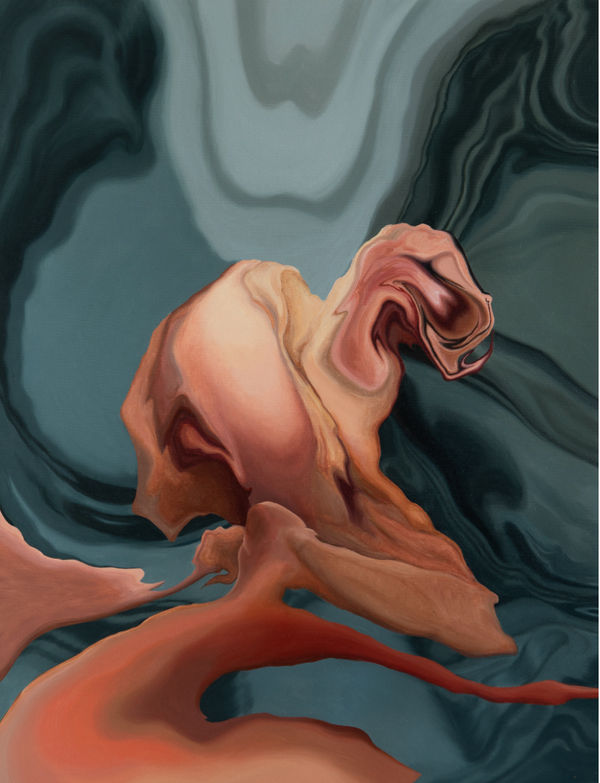


The works of Alfie Rouy and Giulnara Fatullaeva come together in a deeply sensorial encounter that traverses the thresholds between spiritual cosmology and interior psychic experience. Though their visual languages differ, both artists engage painting as a transformative act, a conduit for shifting between states of consciousness, of body, of being.
Alfie Rouy's work, with its expressive gestures and spirit-filled images, enters into conversation with the mystical modernism of the early 20th century, especially with the works of Hilma af Klint and Emma Kunz, who saw in painting the path to spiritual states. His use of automatic drawing refers to surrealist automatism, for example, to the works of André Masson, but Rouy shifts the focus from the Freudian unconscious towards cosmic themes, which echoes the Theosophical motifs in the paintings of Hilma af Klint, created for the temple.
Rouy’s works are perceived as energy fields rather than narrative images: the form is constantly changing, in motion, pulsating with symbolic colors and spiritual energy. The viewer does not analyze the picture, but resonates with it, like a mantra or a certain frequency. His canvases encourage us to abandon the usual view and rebuild our perception.
In contrast, Gulnara Fatullaeva turns toward the psychological and the personal, using figuration to explore themes of dissociation, trauma, and emotional fragmentation. Her figures often ghostlike or disembodied recall the expressive intensity of Edvard Munch, where the human form becomes a vehicle for existential unease. Fatullaeva also engages art history directly, referencing painters such as Delacroix, Courbet, and Watteau. These hommages are not merely stylistic, but conceptual: she disrupts and recontextualizes canonical imagery through a postmodern lens. Her recent project, Les mondes parallèles, delves deeply into the mechanisms of psychological dissociation. Through fragmented bodies and distorted self-images, Fatullaeva stages the sense of detachment from reality, echoing the lasting imprints of childhood trauma. Her work often blurs the boundary between the corporeal and the ethereal, portraying isolation, compression, and suspension in mirrored, dreamlike spaces. In these works, the viewer is invited not just to witness dissociation, but to feel its silent agitation—its fragile balance between presence and absence.
Together, Rouy and Fatullaeva offer two powerful responses to the instability of contemporary consciousness: one turning outward to the cosmic and spiritual, the other inward to the psychological and embodied. Where Rouy's forms invite meditation, Fatullaeva's evoke empathy. Their practices though distinct share a belief in painting as a site of transformation.